

17 December 2025 :
December 15, 2025 - USA. DPI Year End Report 2025
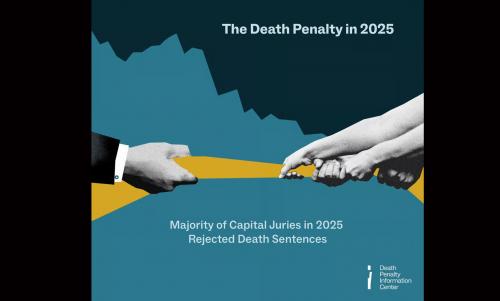
Majority of Capital Juries in 2025 Rejected Death Sentences
The Death Penalty Information Center released its Year End Report today, detailing the death penalty practices of 2025. The Report notes divergent and contradictory trends. On one hand, public opinion polls recorded historically low support for the death penalty, and the highest opposition in 50 years. New research about death sentencing is consistent with these findings. DPIC found that when capital juries were asked to choose between life and death, the majority, 56%*, rejected the death penalty. Stunningly, only 14* juries nationwide were able to unanimously agree to impose death sentences out of more than 50 capital trials. On the other hand, a small number of elected officials pushed executions to their highest level in 15 years, with 48* executions. Florida, which executed only one person in 2024, carried out 19* executions this year – 40% of the national total.
“The increase in this year’s execution numbers was caused by the outlier state of Florida, where the governor set a record number of executions,” said Robin Maher, Executive Director of the Death Penalty Information Center. “The data show that the decisions of Gov. DeSantis and other elected officials are increasingly at odds with the decisions of American juries and the opinions of the American public.”
Use of the death penalty remains extremely isolated and concentrated. Only four states — Florida, Alabama, South Carolina, and Texas — were responsible for nearly three-quarters (72%*) of executions. Just three states — Alabama, California, and Florida — imposed 14* new death sentences, or 64%* of 22* new death sentences this year.
Longstanding concerns about unfairness in the application of the death penalty continued this year. The vast majority (83%) of people executed in 2025 had evidence of serious mental illness, intellectual disability, and/or severe childhood trauma or abuse. Eight were under 21 at the time of their crime. Thirteen people who were executed had been sentenced to death by non-unanimous juries. Ten people executed, including seven in Florida, were military veterans. As standards for representation have improved, defendants with these types of vulnerabilities have become less likely to be sentenced to death.
Methods of execution were the subject of legislation, litigation, and controversy in a dozen states. Louisiana adopted nitrogen gas as a method of execution and ended a 15 year pause with the execution of Jessie Hoffman in March. Witnesses reported that Mr. Hoffman “shook” and “jerked” during his execution. South Carolina continued to use the firing squad despite an autopsy report showing that shooters missed the heart of prisoner Mikal Mahdi in April. In Alabama, Anthony Boyd’s troubling nitrogen gas execution lasted nearly 40 minutes and prompted a passionate dissent from three of the Supreme Court’s justices.
The U.S. Supreme Court denied every request to stay an execution in 2025, a continued retreat from the critical role it has historically played in regulating and limiting the use of the death penalty.
*New death sentence numbers are accurate of December 15, 2025, at 9am ET. These numbers are subject to change if additional death sentences are handed down before the end of 2025. Asterisks indicate numbers that are subject to change. Execution totals include executions scheduled for December 17 and 18.