19 February 2026 :
February 16, 2026 - IRAN. Amirhossein Saeedi killed in hospital.
Victim Accounts: “Security Forces Stormed the House to Seize the Body of Wounded Amirhossein Saeedi”
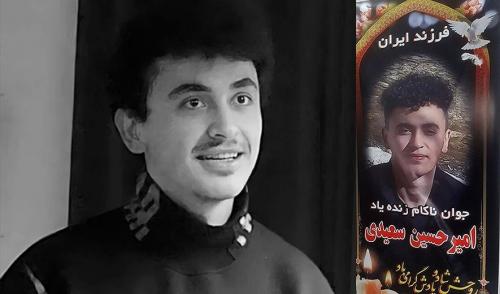
The security forces shot and killed Amir Hossein Saeedi, the 19 year old student during the January 2026 protests in Tehran. In an interview with a person close to his family, IHRNGO has obtained details indicating that his family has since been subjected to security pressure.
Amir Hossein Saeedi, born on 11 May 2006, was a computer engineering student. He was wounded by a direct shot at approximately 10:00 PM on 9 January near the Soleimaniyeh gas station on Pirouzi Street. He was killed later that night at Fajr Hospital on the same street.
The source told IHRNGO: “Security forces began shooting, and he fell to the ground just two meters away from his father. Blood was flowing from under his face and jacket; the bullet hit below his lip. In fact, the bullet entered below Amir Hossein’s lip and exited through the back of his head.”
Amir Hossein’s father carried his son’s wounded body into a nearby house, but security forces broke the windows and stormed the house to take the wounded protester. The source quoted Amir Hossein’s father: “There were about 20 agents. Seven or eight were in green camouflage, seven or eight in tan camouflage, and one dressed in black. Some had fair skin, were stocky, with blond hair and light-colored eyes. They looked like Lebanese or Europeans. Two spoke Persian, the others spoke Arabic or other languages; it wasn't clear where they were from at all.”
According to the source, the agents initially “held a gun to the father’s head and asked about his relationship to the wounded youth, but he denied being his father.” The agents then kicked both of them in the head and face. Eventually, due to the father's resistance and fear of the gathering crowd, they left the victims. “His father carried him on his shoulders, put him in a car and took him to Fajr Hospital,” the source added.
At Fajr Hospital, there was difficulty getting him admitted. A doctor approached and said: “This is one of the protesters.”
“The father,” the source continued, “cleared the blood from his son’s mouth and throat.”
According to the source, instead of laying the wounded Amir Hossein on his side, the doctor laid him flat on his back, and the blood blocked his airway; after 10 minutes, he said Amir Hossein had passed away. The source told IHRNGO: “They did this intentionally; with that volume of blood, he might not have survived, but they could have at least performed a tracheotomy so he could breathe more easily.”
The source continued: “After Amir Hossein was killed, the hospital initially refused to return his mobile phone to his father, claiming he didn’t have one. But the father insisted until he finally recovered the phone and a green prayer bead string that Amir Hossein had with him. They took the body to the morgue and, in the records, wrote ‘unidentified’ instead of his name. His father protested and provided Amir Hossein's details for registration.”
The individual close to the family noted that in his final moments, Amir Hossein told his father: “Dad, I want to fly.”
In the burial permit for Amir Hossein Saeedi, the cause of death is recorded as “impact of high-velocity projectile objects to the body.”
According to the source, on 10 January, Amir Hossein’s body was taken by ambulance to Kahrizak. Quoting members of the Saeedi family, the source said: “The driver had 8 or 9 bodies piled up. Over a thousand bodies were loaded onto a truck. Women who were killed were among the men without undergarments. The trucks were taking unidentified bodies to the salt flats of Qom to be buried with lime.”
The source added that eventually, Amir Hossein’s body was taken to Behesht-e Zahra cemetery by pickup truck and “they provided a family grave to prevent a crowd from gathering.”
The source told IHRNGO that the Saeedi family has faced numerous threats and pressures since then, which continue to this day. According to the source, “Individuals from the local Basij (paramilitary branch of IRGC), a Member of Parliament, and representatives from the Foundation of Martyrs and Veterans Affairs and the Governor's Office have visited th
https://iranhr.net/en/articles/8614/