
16 February 2026 :
January 12, 2026 - IRAN. Hrana Report on 16th Day of Protests: Families of Victims Gather at Behesht Zahra Cemetery
Total Communications Blackout Continues
On the 16th day of nationwide protests in Iran, January 12, the complete internet shutdown and disruption of all communication channels across the country continue, effectively eliminating independent access to information. In this context, aggregated data and documentation compiled by human rights organizations indicate a sharp rise in casualties and arrests.
According to the latest confirmed figures by HRANA, as of this date, 646 people have been killed in the course of the protests. This figure includes 505 protesters (among them 9 minors), 133 military and law enforcement personnel, one prosecutor, and seven non-protesting civilian citizens.
In addition, 579 other reports of deaths remain under review. At the same time, reports have emerged of gatherings and slogan-chanting by families of those killed at Behesht Zahra Cemetery in Tehran, signaling the continuation of protests even in the context of mourning, an issue that, amid the complete communications blackout, has heightened concerns over the true масшале of the crackdown.
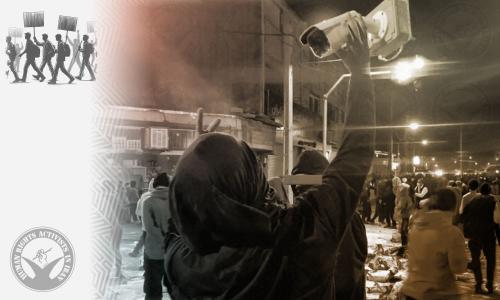
Following 606 gatherings in 187 cities across Iran, protests have continued into the sixteenth day despite the total communications shutdown.
Communications Status: Total Blackout and Information Blockade
On the 16th day of protests, the internet shutdown and the disruption of all communication routes have entered an unprecedented phase. According to published reports, the internet blackout has exceeded 100 hours. In addition to fixed and mobile internet services, telephone calls and other communication tools have been severely disrupted or effectively cut off.
This situation has not only halted public information flows but has also placed serious constraints on the independent verification processes of human rights organizations. Under such conditions, a significant portion of available information is received with delays, through limited and high-risk channels, and the ability to present a complete and up-to-date picture of developments on the ground has been reduced to a minimum.
Statistics
According to HRANA’s latest aggregated and verified data through the end of the sixteenth day of protests:
- 505 protesters have been killed.
- Among them, 9 minors (under the age of 18) have been identified.
- 133 members of military and law enforcement forces have been killed.
- 1 non-military government affiliate (a prosecutor) has died.
- 7 of those killed were non-protesting civilian citizens.
Based on these figures, the total number of confirmed deaths has reached 646 as of this date.
In addition, HRANA has received 579 other reports of deaths that remain under review and verification.
With reliance on supplementary data, the total number of detainees has reached 10,721 to date.
Furthermore, 97 cases of forced confessions by detainees have so far been published by official or government-affiliated media—reflecting the continued security and judicial pressure on those arrested.
Key Field Developments: Gathering at Behesht Zahra, Tehran
One of the most significant developments on the 16th day has been the circulation of reports and videos from Behesht Zahra Cemetery in Tehran. These reports show that families who have received the bodies of those killed in the protests or buried their loved ones gathered at burial sites and chanted protest slogans.
Holding such gatherings in a heavily securitized environment and under conditions of a complete internet and communications shutdown demonstrates the persistence of dissent and protest even in spaces associated with mourning and funeral rites, an indication of the deep connection between street protests and the families’ pursuit of justice for victims.
Official Government Narrative and Escalation of Security Rhetoric
As casualty figures rise, officials of the Islamic Republic and state media continue to emphasize claims of a “fabricated narrative” by media outlets and international organizations, placing responsibility for the violence on “foreign elements,” “terrorists,” and “rioters.”
Against this backdrop, pro-government rallies have taken place in multiple cities and have been lauded by senior officials, while threats of a “no-leniency” response toward protesters, activists, and alleged protest “instigators” have escalated.
International Reactions and Developments Over the Past 24 Hours
At the international level, the sixteenth day of protests was accompanied by a new wave of reactions:
- European leaders and officials expressed “shock” over the intensity of violence used against protesters and accused the Iranian government of presenting a “fabricated narrative” of events.
- The President of the European Parliament announced restrictions on the entry of diplomatic staff and representatives of the Islamic Republic into the Parliament’s buildings, an action seen as a sign of escalating diplomatic tensions between the European Union and Iran.
- Several European governments, including France and Sweden, have evacuated non-essential staff from their embassies in Tehran or advised their citizens to leave Iran due to the deteriorating security situation.
- The governments of Germany, France, and Ireland condemned the “brutal and disproportionate” crackdown on protesters and emphasized the need for an immediate halt to violence and the restoration of internet access.
- In the United States, senior officials once again stated that “various options” in response to developments in Iran are under review, while simultaneously expressing a preference for a diplomatic path.
Documentation Constraints and Security Considerations
The complete internet shutdown and communications blackout, in addition to reducing the flow of information, have created serious security risks for citizens, journalists, and activists inside the country. Under such conditions, the transfer of data, images, and videos is carried out with high risk, and many incidents may never be documented.
HRANA emphasizes that all published figures represent minimum estimates based on verified data, and given the current conditions, there is a strong possibility that these numbers will rise significantly.
Background
Nationwide protests in Iran began on December 28 and today (January 12) mark their 16th day. Since the thirteenth day of protests, the Iranian government has imposed a widespread internet and communications shutdown, effectively placing the country in a state of information blackout.
In this context, the noticeable rise in the death toll, the continuation of mass arrests, the publication of forced confessions, and now the gatherings of families of those killed at Behesht Zahra Cemetery in Tehran paint a troubling picture of escalating repression alongside continued civil resistance and demands for justice.