

16 February 2026 :
February 13, 2026 - USA. DPIC Report on “Women and the Death Penalty”
DPI’s “What to Know” series examines capital punishment from multiple angles.
Although women represent just 2% of death-sentenced prisoners, they have unique issues and have often faced gender biases at every stage of their prosecution.
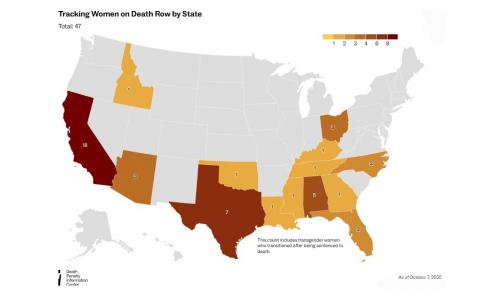
Fewer than 50 women are sentenced to death in the United States (October 2025).
Women represent about 2% of individuals currently sentenced to death in the U.S.
18 women have been executed since 1976, accounting for about 1% of total executions.
Executions of women are historically quite rare, with only 576 documented instances, dating back to 1632. This accounts for 3.6% of the total of 16,047 confirmed executions in the U.S. between 1608 and 2022.
Since 1973, 3 women have been exonerated after being wrongfully convicted and sentenced to death.
Key Facts
Gender-based violence is largely intertwined with women’s experiences and the death penalty. Survivors of domestic abuse are particularly vulnerable to unfair sentencing practices, yet their histories of gender-based violence are frequently overlooked in capital cases. Research shows that at least 96% of women on death row in the U.S. experienced gender-based violence before incarceration, yet this information is often not considered at trial.
Women of color face compounding discrimination in capital cases. Black and Latina women are disproportionately represented on death row and face intersecting biases based on their race and gender. Poverty intensifies these disparities, as economically disadvantaged people generally lack access to quality legal representation and expert witnesses who could present critical mitigating evidence about their histories of trauma and abuse.
Most women were sentenced to death for killing family members in domestic contexts, with more than half of women convicted of crimes involving abusive intimate partners or children of abusive partners.
Tennessee is scheduled to execute its 1st woman in over 200 years. In its September 2025 order, the Tennessee Supreme Court set an execution date for Christa Pike, the only woman on Tennessee’s death row. If executed as scheduled on September 30, 2026, Ms. Pike will be the 1st woman executed in the state in more than 200 years, and the only person the state has executed for a crime committed at age 18, 19, or 20 in the modern death penalty era. Attorneys for Ms. Pike have argued that she suffers from lifelong severe mental illness, trauma, sexual abuse, and neglect. In January 2026, counsel for Ms. Pike filed a lawsuit challenging the state’s lethal injection protocol, asserting it violates her constitutional rights and conflicts with her religious beliefs.
The federal government has executed just 1 woman since the 1950s: Lisa Montgomery. Ms. Montgomery, a seriously mentally ill and traumatized mother of 4, killed a pregnant woman and took her baby. She immediately confessed to her crime. But the jury that convicted her never heard critical details about her childhood that could have explained her life and crime. As a young child, Ms. Montgomery lived in extreme poverty and was severely sexually abused by her stepfather and his friends. Her own mother prostituted her in order to “pay the bills” and at the age of 18, forced her to marry her stepbrother, who continued to sexually and physically abuse her. Her post-conviction legal team found evidence that she sustained one beating so terrible that it left her with a traumatic brain injury. Ultimately, Ms. Montgomery was diagnosed with bipolar disorder, temporal lobe epilepsy, complex-post traumatic stress disorder, dissociative disorder, and psychosis that resulted from her extreme trauma. Most of this information was not found or adequately presented by her inexperienced defense lawyers at trial. Federal prosecutors dismissed the evidence of the sexual abuse that was presented, calling it the “abuse excuse.” Gender bias played a role as well; they faulted her mothering skills, telling the jury that she didn’t go to her children’s events, and that “[s]he didn’t cook, and [s]he didn’t clean.” They told the jury that she lived in a “filthy home.” The jury sentenced her death, and she was executed on January 12, 2021, despite widespread calls for her life to be spared.
Global Perspective
Internationally, women are estimated to represent less than 5% of global death row populations. As of 2023, an estimated 500 to 1,000 women were on death rows in at least 42 countries. In 2024, the few documented executions of women occurred in China (unknown number), Egypt (2), Iran (30), Iraq (1), Saudi Arabia (9), and Yemen (2). Most of these women were sentenced to death for murder or drug trafficking.
For more information about women on death row across the world, see the Cornell Center on the Death Penalty Worldwide, at: https://dpw.lawschool.cornell.edu/
https://deathpenaltyinfo.org/what-to-know-women-and-the-death-penalty