|
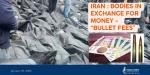
IRAN - “Bullet Fees”
January 23, 2026: January 23, 2026 - IRAN. “Bullet Fees”
Field accounts from multiple Iranian cities show that after killing protesters, the ruling regime in Iran demanded large fees from families to release the bodies of the victims, extending repression from the streets into private life.
What unfolded in Iran in January was not viewed by international human rights mechanisms as isolated incidents or excessive crowd control. The UN Special Rapporteur on the situation of human rights in Iran, Mai Sato, has stated that the pattern of repression, marked by its scale, organization, and direct targeting of civilians, contains the elements of crimes against humanity.
Within this framework, each incident reported across Iranian cities represents part of a broader structural crime. The following account focuses on one of the most explicit manifestations of this pattern; the conditioning of the return of victims’ bodies on the payment of fees, demonstrating how repression continued after death.
Bodies in Exchange for Money; Accounts from Rasht and Tehran
On January 8, at least 70 bodies of protesters were transferred to a hospital in Rasht, while 40 additional bodies were moved to a hospital in eastern Tehran. Witnesses report that security agents demanded 700 million tomans from families to release the bodies.
Local sources state that the morgue at Poursina Hospital in Rasht lacked sufficient capacity, and authorities conditioned the handover of bodies on payment.
“Bullet Fees”: 70 to 250 Million Tomans per Shot
Families report being told they must pay for each bullet used to kill their relatives. According to informed sources, the amounts demanded range from 70 to 250 million tomans per bullet, approximately USD 480 to 1,720, in a country where the average monthly worker income is under USD 100.
Families Unable to Pay
Families unable to meet these demands faced additional pressure. In some cases, bodies were withheld or their locations concealed. One family learned after three days of searching that their relative’s body had been transferred to Kahrizak. Unable to pay, they were forced to accept posthumous Basij membership for their deceased relative.
Extending the Pattern; Mahabad
In Mahabad, reports indicate that the bodies of two victims have not been returned to their families due to non-payment. Families were reportedly pressured to register the deceased under the state-run Martyrs Foundation.
Case of Golaleh Mahmoudi Azar
According to a witness at the memorial of Golaleh Mahmoudi Azar, her body was returned only after payment of 700 million tomans. She was buried in a black body bag, and the family was allowed only three minutes to see her face. Washing, shrouding, funeral announcements, and mourning ceremonies were prohibited. Security forces surrounded the family home, and several attendees were reportedly arrested.
Forced Burials and the Erasure of Mourning
Local sources report repeated cases of forced burials and bans on mourning rituals. In some instances, families were permitted only brief moments to view the bodies.
Observers describe these practices as a deliberate policy to break families’ resilience and instill fear across society.
Continuing Crimes After Street Killings
Observers emphasize that live fire against unarmed protesters, seizure of bodies, monetary demands for their return, and secret burials form a coordinated policy of repression. This policy, they argue, constitutes the continuation of crimes against humanity through psychological and economic coercion against families.
https://iran-hrm.com/2026/01/23/bodies-in-exchange-for-money-bullet-fees-and-the-continuation-of-crimes-against-families-of-the-dead/ (Source: Iran HRM)
|