

10 April 2026 :
April 7, 2026 - USA. Race of Victim Effect and the Death Penalty
The race of victims weighs heavily in capital punishment decisions. Studies confirm that defendants with white victims are more likely to be charged capitally, sentenced to death, have those sentences upheld on appeal, and be executed.
Key Facts:
- Black defendants have been sentenced to death for killing a white person at a rate that is sixteen times higher than white defendants sentenced to death for killing a Black person.1
- Among death sentences imposed from 1972 to 2025, 72% had at least one white victim. During the same time period, 23% of death sentences were imposed on Black defendants with one or more white victims while only 2% of death sentences were imposed on white defendants with one or more Black victims.
These facts were drawn from DPI’s Race of Victim interactive database, which is possible thanks to victim data collected for the period 1972 to 2025 under the supervision of University of North Carolina Professor Frank Baumgartner.
Studies Consistently Show Race and Sex of Victim are Central to Capital Case Outcomes
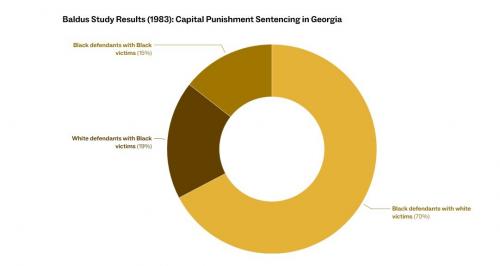
In a 2024 study, researchers expanded on David Baldus’s famous charging and sentencing study of Georgia homicides in the 1970s, to show the continuing impact of the race and sex of homicide victims in death penalty cases — from decisions about who to charge with first degree murder, whether to seek death, who a jury sentences to death, who is successful on appeal, and who is executed. The authors found that “if the victim was a White woman, the District Attorney was more likely to seek death, the jury more likely to impose death, and the condemned defendant was more likely to be executed than if there was no White female victim.”
The researchers validated, and then reexamined the original Baldus data. After controlling for a number of factors that “prosecutors routinely cite” in deciding whether to seek the death penalty, the researchers found statistically significant race and sex effects:
- The odds of a death sentence were “about sixteen times greater” if the victim is a white female compared to a Black male victim.
- The odds were “six times greater” with a white female victim compared to a Black female victim.
- The odds were “three times greater” with a white female victim compared to a white male victim.
Among execution trends, 30% of defendants sentenced to death for the murder of a white female were executed, compared to 19% for the murder of a white male, 10% for the murder of a Black female, and none for the murder of a Black male. These general trends held even when researchers controlled for the severity of the crime.
The study then went beyond the Baldus study timeframe to extrapolate results from nationwide FBI Supplemental Homicide Report (SHR) data through 2019 and execution data from DPI to show that the race of victim findings in Georgia from the Baldus study endure. Between 1976 and 2019, the study identified 3,026 death-eligible defendants. Just eight percent of these cases involved the murder of White female, but those eight percent of cases translated into 52% of defendants executed in Georgia during this timeframe.
The Story of Chip Brownlow
At just 18 years old, Roderick ‘Chip’ Brownlow, a Black teenager from Texas, was murdered in front of his home and family by his white neighbor, Terry Don Woodward, who was wearing a “white pride” garment at the time. Mr. Woodward received a life sentence with a minimum of 30 years — the death penalty was never sought in his case. Researchers Jelani Jefferson Exum and David Niven highlight this case as evidence of the race of victim effect, observing that “the penalties imposed for killing Roderick ‘Chip’ Brownlow and thousands of other Black Americans in Texas were less severe than those imposed for killing White Americans.”