
17 June 2026 :
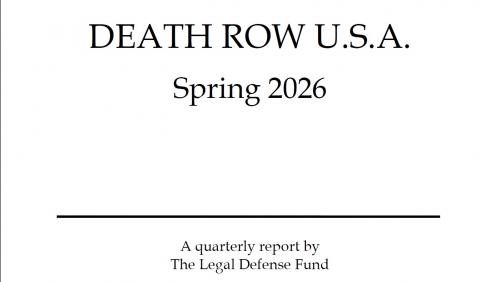
April 1, 2026 - USA. ‘Death Row USA Spring 2026’, the now traditional ‘DRUSA’ report, has been published. It has been published quarterly for over 40 years by the Legal Defence Fund (LDF), formerly known as the NAACP (National Association for the Advancement of Coloured People).
DRUSA Spring 2026, updated to 1 April 2026, records 1,993 people on death row, a decrease of 11 from the previous quarter’s figures. The highest number of prisoners was reached at the end of 2000, when there were 3,726 people on death row.
DRUSA excludes from the total number of prisoners those who have had their death sentences quashed but remain on death row whilst awaiting a retrial or the outcome of the prosecution’s appeals against the quashing. In this report, this figure stands at 97 people.
DRUSA also excludes those sentenced to death in states where a moratorium on executions is in force. These are California, Oregon and Pennsylvania. Apart from Oregon, whose death row is empty, there are 681 prisoners in California and Pennsylvania whose sentences DRUSA considers ‘unenforceable’. As of 1 April 2026, there were therefore 1,215 prisoners in 24 states or on the federal or military death row in the United States who had death sentences that DRUSA considers active and potentially enforceable.
The death penalty is in force in 29 jurisdictions:
Alabama, Arizona, Arkansas, California, Florida, Georgia, Idaho, Indiana, Kansas, Kentucky, Louisiana, Mississippi, Missouri, Montana, Nebraska, Nevada, North Carolina, Ohio, Oklahoma, Oregon, Pennsylvania, South Carolina, South Dakota, Tennessee, Texas, Utah, Wyoming, the US Government (federal), and the US Military (Armed Forces). It should be noted that Oregon and Wyoming have the death penalty in force but have no prisoners on death row. California and Pennsylvania have a moratorium on executions issued by their respective governors.
The death penalty has been abolished in 24 jurisdictions:
Alaska, Colorado, Connecticut, Delaware, District of Columbia, Hawaii, Illinois, Iowa, Maine, Maryland, Massachusetts, Michigan, Minnesota, New Hampshire, New Jersey, New Mexico, New York, North Dakota, Rhode Island, Vermont, Virginia, Washington, West Virginia, Wisconsin. New Hampshire has abolished the death penalty but has not yet resolved the situation of the sole prisoner it had on death row.
Three US states account for half of the country’s death row inmates. California continues to have the nation’s largest death row, with 578 people (560 men and 18 women). Florida follows with 256 people (255 men and 1 woman), followed by Texas, with 168 people (162 men and 6 women).
The other states with 100 or more people on death row are: Alabama (159), North Carolina (124), Ohio (112), Arizona (111) and Pennsylvania (103).
Drusa also takes executions into account, of which there have been 1,661 between 1977 and 1 July 2025. (In 1972, following the Furman v. Georgia ruling, certain aspects of capital punishment laws were declared unconstitutional. The death penalty was reinstated as constitutional in July 1976, following the Gregg v. Georgia ruling. The first execution under the ‘new regime’ took place on 17 January 1977, with the shooting of Gary Gilmore in Utah).
The over-representation of African Americans is confirmed. They make up around 13–14 per cent of the US population, yet account for 34.1 per cent of those executed over the last 48 years. People of Caucasian ethnicity (non-Hispanic whites, according to common US usage) make up around 57–58 per cent of the population and account for 56.1 per cent of those executed. The other main minority groups – Hispanics, Native Americans and Asians – account for 20 per cent of the population and 8.1 per cent of those executed, 2.9 per cent of the population and 1.2 per cent of those executed, and 6.5 per cent of the population and 0.5 per cent of those executed, respectively.
The ethnicity of the victims also appears to influence the outcome of trials in an uneven manner: 75.3 per cent of those killed in cases resulting in a death sentence were white, 15.6 per cent were African American, 6.8 per cent were Hispanic, 0.4 per cent were Native American, and 1.8 per cent were Asian.
Of those executed over the past 48 years, 18 were women and 1,643 were men. The victims whose deaths led to these executions were women in 50.2 per cent of cases and men in 49.8 per cent of cases
https://www.naacpldf.org/wp-content/uploads/DRUSASpring2026.pdf