
01 January 2026 :
January 1, 2026 - IRAN. Report on the Fourth Day of Protests: Expansion of Gatherings and Intensification of the Security Atmosphere
Economic protests and strikes in Iran continued for a fourth consecutive day, marked by a heavy security presence in Tehran and protest gatherings by citizens in other cities, including Isfahan, Fasa, Kuhdasht, Hamedan, Aligudarz, Genaveh, Dorud, Baghmalek, and Kermanshah. Reports indicate the continued widespread deployment of law enforcement and security forces in urban areas, ongoing arrests of citizens, an intensified security atmosphere, gunfire, and violent confrontation in some locations.
Protests that began on the first day with gatherings and strikes by bazaar merchants in Tehran were reported yesterday, December 31, on their fourth day, accompanied by a security clampdown in some Tehran neighborhoods and protest gatherings in several provinces.
Background of the Protests
The ongoing protests have taken shape amid a deepening and multifaceted economic crisis in Iran, marked by an unprecedented surge in foreign exchange rates, the sharp devaluation of the national currency, persistent inflation, prolonged market stagnation, declining purchasing power, the growing inability of tradespeople to sustain economic activity, and widespread uncertainty over future livelihoods.
According to official data, the U.S. dollar has surpassed 140,000 tomans in recent days, alongside reports of massive capital flight from the stock market. A sharp decline in market indices and the movement of capital toward parallel markets such as currency and gold are cited as signs of growing distrust in economic stability. This situation has led to widespread shop closures, market strikes, and the formation of protest gatherings across the country.
Geography of the Protests
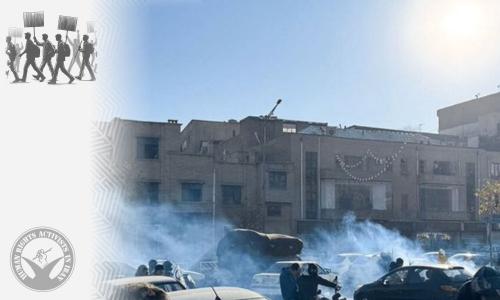
Based on collected information, videos published on the fourth day show the deployment of riot control forces and equipment and crowd-control measures on Valiasr Street, the intersection of Imam Khomeini Street in Tehran, and streets in the city of Qods.
In the provinces, protests continued to spread. Reports indicate gatherings in front of the Fasa County Governor’s Office on Jomhouri Street, at Naqsh-e Jahan Square in Isfahan, as well as in Kuhdasht, Nobahar Street in Kermanshah, Aligudarz, Dorud, Genaveh, Baghmalek, and Hamedan. A video published from Kuhdasht shows confrontations between protesters and law enforcement and security forces. Additionally, shopkeepers in Ahmadabad Square and Yakhchal Street in Isfahan refused to carry out their activities and went on strike.
Universities Join In and Student Protests
On the fourth day of protests, published videos showed the continuation of student protests at Isfahan University of Technology for a second consecutive day. The footage shows a group of students marching and chanting slogans on the university campus.
Methods of Protest and Slogans
The fourth day of protests featured a combination of labor strikes, gatherings, and street marches. Bazaar merchants played a central role in sustaining the protests by closing their shops and calling on other tradespeople to strike. According to verified videos, slogans such as “Death to the dictator,” “Honorable bazaar merchants, support, support,” “Woman, Life, Freedom,” and “Man, Homeland, Prosperity” were heard in various locations.
Actions by Law Enforcement and Details of Violence
Reports indicate that in several areas, law enforcement and security forces used tear gas to disperse protesters. In Fasa County, citizens’ protests escalated into violence following the intervention of law enforcement and security forces. Published images show officers firing toward protesters. The head of the Fasa judiciary stated that three law enforcement officers were injured.
Arrests and Security Pressure
During last night’s protests and yesterday’s demonstrations, at least 16 citizens were arrested. HRANA reported the arrests of Sultan Emamkhah, Amir Mehdi Razm, Abolfazl Jafsh, and Abolfazl Ashnoud in Behbahan County for issuing a call for citizens to participate in protests. Among them, Sultan Emamkhah has been released. Tasnim News Agency also quoted an informed source at the Ministry of Intelligence as saying that seven citizens had been arrested, claiming that “these individuals were affiliated with opposition groups and intended to turn the protests violent.”
Additionally, the head of the Fasa judiciary stated that during clashes between law enforcement and security forces and protesters in front of the county governor’s office, four protesting citizens were arrested. Some channels close to security institutions reported that one of those arrested was a 27-year-old woman.
Separately, a video circulating on social media shows the person filming reporting the arrest of a citizen by plainclothes security forces in Tehran’s bazaar and calling on others to intervene to prevent the arrest. No information is available regarding when the video was recorded.
Reactions of Officials and State Media
In response to the protests, Mehr News Agency described the gathering of citizens in Fasa County as a “riot” and claimed in a report that no military weapons were used in suppressing the protesters, declaring the situation in Fasa to be calm. The official Sabrin News channel also claimed that officers used launcher weapons with plastic pellet ammunition to disperse individuals near the governor’s office.
Meanwhile, the Governor of Tehran Province claimed that the police’s policy had been one of restraint and that citizens had not been arrested for protesting. Mohammad Sadegh Motamedian asserted that police actions were taken only in limited cases following road blockages and minor clashes, and that no precise assessment of the number of detainees had yet been compiled.