
02 March 2026 :
March 1, 2026 - IRAN. Hrana Report: The Second Day of the U.S.–Israel and Iran War
Rising Civilian Casualties
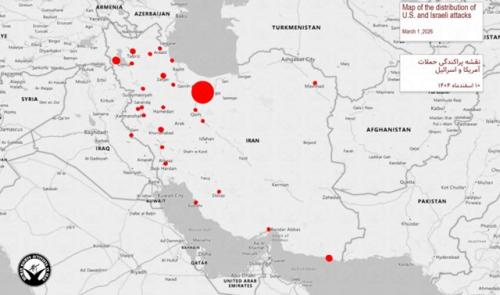
On March 1, 2026, based on recorded data, at least 72 incidents were reported across 20 provinces. Tehran ranked first with 37 incidents (51%). The composition of the attacks included 39 missile strikes (54%), 32 incidents with unspecified methods (44%), and one airstrike. At the same time, the targeting of at least 30 sites or facilities in 12 provinces was recorded, including 15 military-security targets, 7 civilian infrastructure sites, 5 medical centers or emergency bases, 2 residential homes, and one school.
Over the past 24 hours the crisis stemming from the U.S. and Israeli attack on Iran entered a new phase. The scope of attacks expanded across the country, and based on daily data, at least 72 incidents were recorded in 20 provinces. Attacks on Tehran increased markedly. Political developments as well, including the confirmation of Ayatollah Ali Khamenei’s death and the circulation of conflicting reports regarding the fate of Mahmoud Ahmadinejad, further deepened the atmosphere of uncertainty and tension within the public sphere.
In terms of human casualties, reports indicate a rising number of child victims following the attack on a school that was targeted the previous day, an incident that, due to the nature of the site and the profile of the victims, has become one of the most sensitive aspects of the crisis. In the same context, multiple reports also emerged today about damage to Gandhi Hospital in Tehran and the evacuation of patients, including children.
Meanwhile, the continued severe disruption and near-total internet shutdown, which independent reports have described as “close to a nationwide blackout”, has effectively hindered the flow of information, on-the-ground verification, and citizens’ access to safety information, increasing the time gap between the occurrence of incidents and the documentation of their details.
Overview of the Attacks and Pattern of Incidents
Based on recorded data from developments on March 1, at least 72 incidents were reported and documented across 20 provinces in Iran. In terms of geographic spread, method of attack, and timing, these incidents point to the continuation of coordinated and simultaneous waves of strikes. (For comparison, at least 60 incidents had been recorded on February 28.)
In terms of geographic distribution, Tehran Province ranks first with 37 incidents, accounting for more than half of all recorded incidents today (approximately 51%). It is followed by East Azerbaijan and West Azerbaijan provinces, each with 4 incidents. The provinces of Alborz, Sistan and Baluchestan, and Zanjan each recorded 3 incidents, while Lorestan, Kurdistan, Kermanshah, and Khuzestan each recorded 2 incidents. In addition, several other provinces each registered a single incident, confirming the broad geographic scope of today’s attacks.
Regarding the type of attack, today’s data shows that missile strikes continue to account for the largest share, although their proportion has decreased compared to the previous day:
▪ Missile attacks: 39 cases (approximately 54%)
▪ Method of attack unspecified: 32 cases (approximately 44%)
▪ Airstrike: 1 case (approximately 1%)
This shift is significant because while missile strikes were far more dominant the previous day, today there has been a noticeable increase in incidents for which the method of execution has not yet been definitively determined.
Regarding the weapons used, the data show that in 47 incidents cruise missiles were employed (approximately 65%), while in 25 incidents the weapon/method remained unspecified (approximately 35%). Notably, in today’s data no drone incidents were recorded as a distinct category, and a significant portion of the uncertainty appears to be reflected under the label “unspecified method.”
In terms of timing, incidents were concentrated in two primary time windows:
▪ 10:00–14:00: 36 incidents (approximately 50%)
▪ 21:00–22:00: 20 incidents (approximately 28%)
In addition, a smaller cluster occurred between 18:00 and 20:00 (13 incidents, approximately 18%). This pattern may be consistent with attacks carried out in multiple phases, although it should be noted that the “time of registration” does not always precisely correspond to the “time of occurrence.”
Regarding the nature of the targets, a significant portion of incidents still requires further clarification; however, today’s breakdown is clearer than in previous reports:
▪ Unspecified targets: 34 cases (approximately 47%)
▪ Military targets: 22 cases (approximately 31%)
▪ Civilian objects: 9 cases (approximately 13%)
▪ Dual-use objects: 7 cases (approximately 10%)
In the assessment of damage, more than half of the recorded incidents were classified as causing severe damage:
▪ Severe: 41 cases (approximately 57%)
▪ Unspecified: 30 cases (approximately 42%)
▪ Minor: 1 case
Across all incidents recorded today, no instances of prior warning before the attacks were documented, and no specific cases of displacement were reported. In terms of verification status, 70 incidents (approximately 97%) are categorized as “confirmed,” while 2 incidents remain under “initial confirmation.”
This preliminary overview indicates that on March 1 there was an increase both in the number of incidents and in their provincial spread, while the geographic concentration of attacks shifted markedly toward Tehran. More detailed information regarding the nature of the targets, humanitarian consequences, and the extent of damage, particularly in incidents categorized under “unspecified method”, will become clearer in subsequent reports as verification processes are completed.
Civilian Casualties and Preliminary Assessment
Based on recorded reports concerning developments on March 1, and after removing duplicate or overlapping entries, at least 6 civilians have been killed and 4 civilians injured as of the time of writing, a total of at least 10 civilian casualties directly attributed to today’s incidents.
In terms of geographic distribution, the highest number of recorded fatalities today relates to Tehran Province. Reports indicate 6 deaths in Tehran, including one worker killed following an attack on a workshop in the Shariati Street area, as well as a separate report of 5 people killed in Tehran’s District 12 (further details regarding the identities of the victims and the specifics of this case remain limited).
The recorded cases of injured civilians pertain to West Azerbaijan, Hamadan, and East Azerbaijan provinces: 2 individuals were injured in Urmia following the targeting of an educational center, and 2 others were injured in Hamadan and Sarab, both reported in connection with attacks on emergency bases that resulted in injuries to healthcare personnel. This pattern indicates that, alongside urban areas, public service and emergency facilities are also among the affected sites.
In addition to the above cases, for which the date and location are specified, one further death has been recorded within the past 24 hours for which the exact date and geographic coordinates remain unclear, with the report referring only to a “fatality in airstrikes.” Due to the lack of sufficient detail, this case has been kept separate from today’s geographic summary.
At the same time, it should be noted that part of the information registered over the past 24 hours pertains to February 28 and is retained in this daily report solely for record-keeping purposes. Given the ongoing restrictions on information flow, the figures may increase and further details may emerge, particularly in cases initially recorded with limited information, in subsequent updates.
Military Casualties and Preliminary Assessment
Based on recorded data from March 1, and after consolidating reports to avoid double counting, the minimum distinguishable estimate indicates that at least 6 military-security personnel were killed today. Additionally, reports also point to a number of injured personnel; however, in some cases the exact figures and the breakdown between killed and wounded have not yet been consistently established.
In terms of geographic distribution, the reported military casualties today were primarily recorded in West Azerbaijan, Kermanshah, Isfahan, and Ilam provinces, with a notable concentration in the northwest of the country and several significant incidents in western Iran.
The most prominent focal point of today’s casualties is Urmia, where reports indicate the killing of four Law Enforcement Command (FARAJA) members, including two colonels. The announced names are: Seyyed Qassem Razavi (Colonel), Ourj-Ali Dorosti (Colonel), Yaser Mikaeili (Second Lieutenant), and Mohammad Reza Norouzi (conscript soldier). The simultaneous loss of multiple ranked police officers in a single city signals a significant blow to the internal security structure in this axis.
In Kermanshah, at least one report indicates fatalities following an attack on a Basij base in the Ta’avon Township. In Ravansar, reports also point to an attack on an IRGC headquarters; in this location, at least one death has been clearly recorded, and several injuries have been reported, although the exact number has not been specified.
In Kashan (Isfahan Province), an official report announced the killing of at least 12 IRGC members in airstrikes. Due to the aggregate nature of this figure and the absence of a detailed list of names in the initial data, it has not been incorporated into the “minimum distinguishable estimate.” Nevertheless, from a reporting perspective, it represents one of the most significant figures published today.
In Mehran (Ilam Province), reports indicate heavy casualties following an attack on a border regiment headquarters. Some accounts refer to the killing of 21 individuals (including both career personnel and conscript soldiers), while other reports mention additional injuries. Given discrepancies in the initial reporting, a definitive and disaggregated summary of the number of wounded is withheld at this stage to avoid statistical inaccuracies.
Overall, according to the reports received, FARAJA and IRGC forces have sustained the highest number of casualties. As field details are completed and the breakdown of casualties in aggregated reports becomes clearer, a more precise picture of the final number of those killed and injured is expected to be presented in subsequent updates.
Damage to Infrastructure and Facilities, and a Preliminary Overview of Target Types
Based on recorded information from the incidents of March 1, at least 30 distinct targets or facilities across 12 provinces have been listed among the damaged sites, a list that is broader than the previous day both in terms of number and diversity of target types.
In terms of geographic distribution, Tehran accounts for the largest share, with 14 targets (nearly half of all targets recorded today). It is followed by Kurdistan with 4 targets, and then West Azerbaijan and Sistan and Baluchestan with 2 targets each. Other provinces — including Kermanshah, Khuzestan, Razavi Khorasan, Ilam, Alborz, Hamadan, Qazvin, and East Azerbaijan — each have at least one recorded target. This pattern indicates that the damage was not confined to a limited number of locations but extended across a considerable provincial range.
Regarding the type of targets, today’s composition appears more layered:
▪ 15 cases fall within the category of military-security bases and facilities.
▪ 7 cases have been recorded as civilian infrastructure and facilities.
▪ A particularly significant and sensitive development today is the registration of 5 cases involving hospitals or emergency bases, facilities that ordinarily receive special protection under international humanitarian law and whose damage carries heightened humanitarian sensitivity.
▪ Additionally, 2 cases were recorded in the category of residential homes and 1 case in the category of a school.
Among the reported military and security targets, several are politically and operationally significant. These include reports concerning the building of the General Staff of the Armed Forces and the Army Joint Staff in Tehran. There are also reports of Basij bases being targeted in Tehran, as well as initial confirmation reports regarding the Doushan Tappeh/11th Tactical Air Base. Outside Tehran, today’s data also include the targeting of the Fourth Tactical Air Base in Dezful, the Mehran border regiment headquarters, an IRGC base in Karaj, and IRGC missile bases near Kamyaran. In Kurdistan, the targeting of Kamyaran Police Station No. 11 has also been reported, which falls within the domain of internal security targets.
Today’s list of civilian targets includes several cases of particular news significance: reports indicate the targeting of the Revolutionary Court in Tehran, the national wrestling teams’ training camp and facilities of the Handball Federation, as well as a private workshop. Outside Tehran, Mashhad’s Hashemi Nejad International Airport is also among the recorded targets. In Kurdistan, the targeting of a Gas Company office has been reported, which may be particularly sensitive in terms of its impact on public services.
In the area of health- and emergency-related targets, reports today referred to damage to Khatam al-Anbia, Motahari, and Gandhi hospitals in Tehran. In addition, emergency bases in Hamadan and Sarab (East Azerbaijan) appear on the list of affected sites. The simultaneous registration of multiple medical and emergency facilities in a single day constitutes an important humanitarian indicator in assessing the consequences of the attacks.
In terms of verification status, 28 of the targets recorded today are categorized as “confirmed,” one is under “initial confirmation,” and one remains “under review.” In at least 7 cases, visual evidence (video or video accompanied by reports) is available alongside written accounts, which may assist in further verification and geolocation in subsequent stages.
However, today’s data still contain significant gaps in two key areas: first, in most cases the operational status of facilities after the attack and the extent of service disruption remain unclear; second, no numerical estimate of the number of people affected has been recorded for any of today’s targets. Therefore, assessing the scope of indirect impacts, particularly in cases involving infrastructure and medical facilities, will require additional field information and future updates.
Overall, today’s picture shows that alongside the continued targeting of military facilities, the scope of damage has meaningfully expanded toward civilian sites, public services, and even medical and emergency centers, a trend that may prove decisive in future assessments of the humanitarian and legal consequences of the attacks.
https://www.en-hrana.org/the-second-day-of-the-u-s-israel-and-iran-war-rising-civilian-casualties/