
09 March 2026 :
March 8, 2026 - IRAN. Hrana Report on 9th day of war
Polluted Air and Black Rain in Tehran
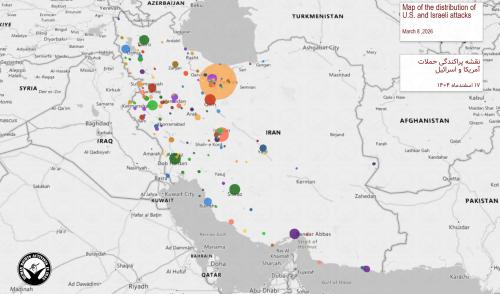
In the last 24 hours, and as of March 8, 2026, at 17:00 ET, HRANA has recorded at least 752 attacks across 148 incidents in 30 provinces, resulting in a total of at least 83 casualties (killed and injured, both civilian and military). The recent attacks have geographically spread across the entire country, although the focus of the strikes still remains on Tehran and several specific provinces.
According to information recorded and verified by HRANA, from the first minutes of the day until the end of March 8, 2026 (Tehran time), at least 33 people were killed and 50 others injured. These cases have been documented at the incident level, but their classification (civilian or military) is not specified in the available data. Therefore, to avoid classification errors, they are presented in this report under the category of “unspecified.”
Aggregated data since the beginning of the conflict on February 28, 2026, based on incidents recorded in the incident tab and using minimum values for figures marked “more than”:
- Civilian fatalities: 1,205 people (including at least 194 minors)
- Military fatalities: 187 people
- Unclassified fatalities (civilian/military): 316 people
This remainder of this report provides a preliminary analytical overview of documented incidents over the past 24 hours. All figures and classifications are based on information available at the time of publication. As verification continues and more information becomes available, casualty figures and classifications may be updated.
1 - Overview of Incidents in the Last 24 Hours
In the last 24 hours, incidents were reported across multiple provinces, reflecting a geographically dispersed pattern of hostilities. In a large portion of the incidents, the method/type of attack has not yet been confirmed and has been recorded as “undetermined.” In cases where the attack type was identifiable, airstrikes and drone attacks were reported.
Preliminary analysis indicates that Tehran Province, accounting for 34% of the attacks, continues to be targeted more than any other part of the country. After that, as on the previous day, the provinces of Isfahan (about 8%) and Kermanshah (about 6%) recorded a larger share of today’s attacks. As in previous days, Khuzestan, Alborz, and several western provinces of the country account for the next highest shares of the attacks.
2 - List of Objects Reported Hit
In the past 24 hours, the targeting or damage of 124 unique objects or facilities has been confirmed. These objects include a range of targets. Please note that this list includes not only objects reportedly directly targeted, but also those documented as damaged as a result of nearby strikes or blast effects.
Examples of targets recorded in the past 24 hours:
- Kamal Esmail Basij Base (Isfahan)
- Army Garrison (Isfahan)
- IRGC Al-Ghadir Brigade 18 (Shahin Shahr, Isfahan)
- Border Guard Command Headquarters (Kermanshah)
- Paveh Border Regiment (Paveh, Kermanshah)
For a number of the listed targets, the exact nature of the target (civilian/military/dual-use) is still under review, and classifications may be revised as additional information becomes available.
3 - Facilities Protected Under International Humanitarian Law:
Under international humanitarian law, medical facilities, educational institutions, humanitarian facilities, religious sites, and emergency service centers are among the many objects that maintain special protected status and are afforded special protection. In the past 24 hours, HRANA has preliminarily recorded the following cases:
- Oil Storage Facilities in Tehran and Karaj
- Fajr Kaveh Swimming Complex (Isfahan)
- Mellat Stadium (Shahin Shahr)
- Seminary School Building (Qom)
- Judiciary Building (Zarrin Shahr)
4 - Civilian Casualties
Over the past 24 hours, no cases have been actively recorded as confirmed civilian casualties.
5 - Military Casualties
During the period covered by this report, no cases have been actively recorded as confirmed military casualties. Military casualties are generally reported in the context of attacks on Army and Islamic Revolutionary Guard Corps (IRGC) bases.
In some incidents, individuals have been killed in the vicinity of military targets; however, their official status has not yet been definitively determined. These cases remain under review, and if reliable information indicating a different status becomes available, the classification may be revised accordingly.
It is believed that military casualties are significantly higher than the figures reported in these reports. However, due to the sensitive nature of military information and the limited access of human rights groups and media to locations where military forces are present, this section largely reflects reports of senior officers or military personnel who were present in urban areas.
6 - Unverified Casualties
Among the data recorded for the past 24 hours, no cases have been registered as unconfirmed casualties.
7 - Confirmed but Unspecified Casualties
At the time of publication, 33 deaths and 50 injuries recorded over the past 24 hours remain classified as “unspecified.” This means that HRANA News Agency has not yet been able to determine with sufficient certainty whether these individuals were civilians or military personnel.
Burials: Today, 13 burial cases resulting from attacks on previous days have been recorded.
A Note on HRANA Methodology
Note that, in line with HRANA policy, this report reflects only incidents that occurred within the territorial borders of Iran.
The information contained in this report is compiled through HRANA’s established documentation network. Data is collected from a combination of field reports, local contacts, medical and emergency sources, civil society networks, and open source materials, including publicly available images, videos, and official statements where relevant. Each reported incident is logged and assessed through an internal review process before publication.
Given the evolving nature of hostilities, information is gathered on a rolling basis and reflects the status of documentation at the time of publication.
The figures presented in this report may not reflect the full scope of harm. Ongoing hostilities, damage to infrastructure, communication disruptions, restricted access to affected areas, and security risks for sources may limit the ability to document incidents comprehensively.
Delays in medical reporting, difficulties in confirming identities, and restricted access to certain provinces may result in temporary undercounting. As access improves or additional evidence emerges, casualty figures and incident classifications may be revised accordingly.
HRANA remains committed to transparency, methodological rigor, and the continual updating of its findings as new verified information becomes available.
Humanitarian Obligations
Skyler Thompson, Deputy Director of the Human Rights Activists in Iran, told HRANA that the organization is increasingly concerned about the impact the recent attacks have had on the civilian population. Beyond the immediate deaths and injuries inflicted on civilians, reports indicating that a desalination plant was targeted are particularly alarming. “Such facilities are presumptively civilian objects and constitute infrastructure indispensable to the survival of the civilian population. Under international humanitarian law, directing attacks against civilian objects is unlawful, and attacks on objects indispensable to civilian survival are strictly prohibited.”
Ms. Thompson emphasized that “Strikes on oil refinery infrastructure are equally concerning given the environmental and public health consequences they may trigger in a densely populated capital city of over ten million people. Damage to such facilities risks releasing toxic pollutants and causing environmental harm that can endanger civilian health on a large scale.”
The human rights advocate also stressed that the organization has received reports indicating that the consequences of these attacks have damaged critical infrastructure, including two dialysis centers upon which civilians depend for life-sustaining treatment. Overall, these attacks raise serious concerns regarding the principle of proportionality under international humanitarian law, particularly where the foreseeable harm to civilians, essential services, and the environment may be widespread and long-lasting.
Ms. Thompson concluded by stating that Human Rights Activists in Iran once again calls for the immediate end of the hostilities and urges all parties to take eve