
09 March 2026 :
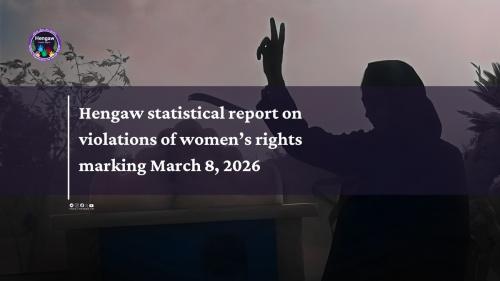
March 8, 2026 - IRAN. Hengaw report on violations of women’s rights
At least 250 women killed during the January protests
Hengaw has released a statistical report marking March 8, 2026, International Women’s Day, documenting killings, executions, arrests, and other violations of women’s rights in Iran. The report first presents data on women killed during the January 2026 protests, followed by broader statistics on violations of women’s rights across the country.
According to data documented by Hengaw, at least 250 women were killed during the January protests. In addition, during 2025, at least 55 women were executed, 80 women were sentenced to punishments including imprisonment, flogging, or the death penalty, 182 women were arrested, and 207 cases of femicide were recorded across Iran.
Brief overview of women killed and arrested during the January 2026 protests
At least 250 women were killed by Iranian government forces using live ammunition during the late-December to January 2026 protests in cities across Iran. Hengaw has so far verified the identities of 204 of these victims.
In addition, at least 25 girls under the age of 18 were killed, with the identities of 19 victims verified by Hengaw.
Provinces with the highest number of women killed:
Tehran Province: 61 women
Isfahan Province: 29 women
Alborz Province: 24 women
Gilan Province: 23 women
Razavi Khorasan Province: 22 women
Among the victims were:
At least 22 university students
At least 2 teachers
At least 7 doctors, nurses, or medical staff
Hengaw has also verified the identities of 263 women arrested during the recent protests by Iranian authorities.
Execution of 55 women in 2025
According to Hengaw data, at least 55 women were executed in prisons across Iran during 2025, marking the highest number of executions of women recorded in the country in the past 25 years.
Breakdown by charges
Religious activity: 1 case
Murder: 36 cases
Drug-related offenses: 18 cases
Additional details
At least 11 Turkish women were executed.
At least 3 Lor women, 2 Gilak women, and 2 Kurdish women were executed.
The highest number of executions of women (9 cases each) occurred in Fars Province and Razavi Khorasan Province.
At least 6 women were executed in Isfahan Province.
At least two executions were carried out secretly, without allowing prisoners a final meeting with their families.
Only 4 executions, or 7 percent, were announced by state media.
Iran ranks among the countries with the highest numbers of executions of women worldwide.
Prison, flogging, and death sentences issued against women activists
During 2025, at least 80 women activists were sentenced by the judiciary of the Islamic Republic of Iran to punishments including imprisonment, flogging, and the death penalty.
According to Hengaw data:
Two women activists — Nasimeh Eslamzehi, a Baloch citizen, and Zahra Shahbaztabari, a Gilak citizen — were sentenced to death.
At least 78 women activists were collectively sentenced to 354 years, 10 months, and 12 days of imprisonment.
At least two women activists were sentenced to a total of 252 lashes.
At least three women activists received a combined sentence of nine years of suspended imprisonment.
Groups receiving the highest number of sentences
20 Baha’i women activists were collectively sentenced to 88 years, one month, and one day of imprisonment.
At least 8 Kurdish women activists were sentenced to 18 years and 9 months of imprisonment.
At least one Gilak woman activist was sentenced to death, while seven others received a combined sentence of 9 years and 7 months of imprisonment.
Arrest of at least 182 women in 2025
In 2025, Hengaw documented and verified the arrest of at least 182 women in cities across Iran. These cases include women detained due to political, religious, civil activities, or participation in protests.
Further details on arrests
Based on Hengaw statistics, at least 182 women were arrested during 2025 in connection with political, religious, civil activities, or participation in protests, accounting for 11 percent of all arrests recorded that year.
Among those arrested:
51 Baha’i women
41 Kurdish women
14 Gilak women
10 Lor women
6 university students
3 teachers
Arbitrary arrest, abduction, and unlawful detention of women—alongside the issuance of heavy sentences for civil and political activities and opaque judicial proceedings in cases related to murder and drug charges—form part of the judicial mechanisms used within the Islamic Republic of Iran’s broader system of repression against women.
207 cases of femicide recorded in 2025
According to data from the Statistics and Documentation Center of Hengaw Organization for Human Rights, at least 207 cases of femicide were recorded in Iran in 2025. Among these cases, 31 killings (14.5 percent) were linked to so-called “honor” motives.
Additional details:
At least 13 women were killed after rejecting marriage proposals
At least 10 women were murdered by their husbands after requesting divorce
At least 10 women who had been subjected to child marriage were later killed by their husbands
At least 7 women who were victims of forced marriage were killed
Provinces with the highest number of femicides
Tehran Province: 32 cases
Mazandaran, Razavi Khorasan, and West Azerbaijan Provinces: 14 cases each
Kermanshah (Kermashan) Province: 13 cases
East Azerbaijan, Fars, and Sistan and Baluchestan Provinces: 11 cases each
Gilan and Lorestan Provinces: 10 cases each
Kerman Province: 7 cases
Khuzestan and Alborz Provinces: 6 cases each
Most femicides were carried out by individuals closest to the victims, including husbands, former husbands, fathers, brothers, and other family members, reflecting a consistent pattern in many femicide cases.
The registration of these statistics takes place in a context where, due to the anti-women laws of the Islamic Republic of Iran, as well as “honor-based” norms, patriarchal traditions and social taboos within Iranian society, a significant portion of femicides remains hidden within what can be described as “dark figures.” According to international standards, wherever statistics are inaccurate or lack transparency, it indicates that a larger tragedy of femicide may be unfolding.
In the absence of effective legal mechanisms, it is primarily civil society organizations and independent groups that are able to document cases of femicide. However, such organizations do not exist in many parts of Iran, which is one of the main reasons why accurate statistics on femicide are unavailable in certain regions of the country.
Brief overview of violations of women’s rights in Kurdistan in 2025
At least two Kurdish women from Ilam and Urmia were executed in Shiraz and Urmia prisons on charges related to drug offenses and premeditated murder.
At least 8 Kurdish women activists were sentenced to 18 years and 9 months of imprisonment.
At least 2 Kurdish women activists were collectively sentenced to 6 years of suspended imprisonment.
At least 41 Kurdish women activists were arrested by Iranian authorities.
Femicide cases recorded in cities across Kurdistan
According to Hengaw statistics, at least 30 femicide cases were recorded across various cities in Kurdistan.
Breakdown by province:
Kermanshah Province: 13 cases
West Azerbaijan Province (Urmia): 6 cases
Kurdistan Province: 5 cases
Ilam Province: 5 cases
North Khorasan Province: 1 case
Kurdish women killed and arrested during the late-December to January 2026 protests
Hengaw’s verification team has so far confirmed the identities of 24 Kurdish women killed during the January protests.
Among them:
11 women were killed in Tehran Province
5 in Kermanshah Province
3 in Alborz Province
2 in Gilan Province
2 in North Khorasan Province
1 in Razavi Khorasan Province
In addition, at least three Kurdish girls under the age of 18 were killed during the protests after being shot by Iranian government forces.
Hengaw’s Statistics and Documentation Center has also verified the identities of 50 Kurdish women arrested during the recent protests.
https://hengaw.net/en/reports-and-statistics-1/2026/03/article-4