
31 March 2026 :
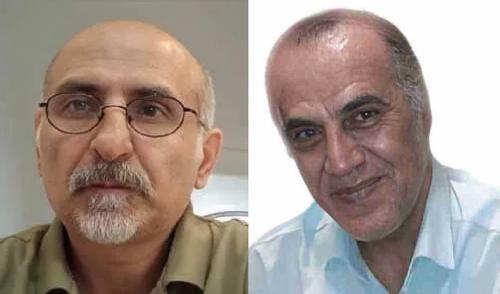
March 30, 2026 - IRAN. Executions of Political Prisoners Ali Akbar Daneshvarkar and Mohammad Taghavi Sangdehi
Accused of involvement in the January Protests and being members of the People’s Mojahedin Organisation of Iran (PMOI/MEK)
Mizan, the Judiciary Media Center, announced that the death sentences of Akbar Daneshvar-Kar and Seyed Mohammad Taghavi Sang-Dehi, political prisoners, were carried out at dawn on Monday, 30 March 2026.
The semi-official Tasnim news agency, affiliated with the Islamic Revolutionary Guard Corps (IRGC), reported Monday that Daneshvarkar and Taghavi-Sangdehi were accused of links to the dissident Mojahedin Khalq Organization (MKO/MEK) – a leftist Islamist group established before Iran’s 1979 Islamic Revolution.
According to IHR (Iran Human Rights), they were subjected to physical and psychological torture, denied due process rights and sentenced to death in a process that did not meet minimum fair trial standards. The defendants were executed while awaiting a decision from the Supreme Court.
Condemning their executions in the strongest terms, Iran Human Rights warns of an impending wave of executions targeting political prisoners and protesters under the shadow of war.
IHR Director, Mahmood Amiry-Moghaddam stated: “Ali Akbar Daneshvarkar and Mohammad Taghavi Sangdehi had been subjected to torture and sentenced to death after grossly unfair trials. Their death sentences and executions are unlawful and must be condemned by the international community. We fear that the Islamic Republic will exploit the current war time conditions to carry out mass executions inside prisons, to instill societal fear. The regime’s primary existential threat does not come from war, but from its own people demanding fundamental change.”
Ali Akbar and Mohammad’s four co-defendants, Babak Alipour, Vahid Baniamerian, Pouya Ghobadi and Abolhassan Montazer, are at grave and imminent risk of execution in Ghezelhesar Prison.
According to the judiciary’s Mizan News Agency, political prisoners Ali Akbar Daneshvarkar and Mohammad Taghavi Sangdehi were hanged at an unspecified location on 30 March 2026. IHR has established the location of their executions as Ghezelhesar Prison in Alborz province.
Ali Akbar Daneshvarkar (Shahrokh), a 59-year-old civil engineer and father, was arrested at his home in Tehran on 3 January 2024. Mohammad Taghavi Sangdehi, a 60-year-old former political prisoner and survivor of the 1988 Massacre, was arrested in Chaldaron on 23 February 2024. Mohammad was held in the solitary confinement cells of Ward 209 of Evin Prison for almost a year.
Along with co-defendants Babak Alipour, Vahid Baniamerian, Pouya Ghobadi and Abolhassan Montazer, they were subjected to physical and psychological torture, including mock executions, to coerce confessions, held in prolonged solitary confinement and denied access to their lawyers. Mohammad’s two younger brothers were also arrested as further psychological pressure.
The six political prisoners were sentenced to death by Branch 26 of the Tehran Revolutionary Court, presided over by Judge Iman Afshari, on 25 November 2024. They were sentenced on charges of baghy (armed rebellion) through membership of the People’s Mojahedin Organisation of Iran (PMOI/MEK), with each receiving additional prison and exile terms for charges including “assembly and collusion against national security.” According to their families, the political prisoners were only granted minutes to defend themselves.
In July 2025, their sentence was overturned by the Supreme Court and their case was referred to a court of equal standing for retrial. They were retried by Judge Iman Afshari at Branch 26 of the Tehran Revolutionary Court in November and resentenced to death on 7 December 2025.
It is not clear when their sentence was upheld by the Supreme Court. According to informed sources, their relatives were awaiting news of the Supreme Court decision when the executions took place. As prison visitations are currently suspended, it is highly likely that Ali Akbar and Mohammad may have been denied last family visits.
Their co-defendants Babak Alipour, Vahid Baniamerian, Pouya Ghobadi and Abolhassan Montazer are at great risk of execution in Ghezelhesar Prison. Babak Paknia, the lawyer for three of the defendants, confirmed that the lawyers in the case have not been informed of the Supreme Court decision.
In April 2025, authorities attempted to forcibly transfer the six political prisoners from Evin Prison to Ghezelhesar Prison which the political prisoners prevented through their resistance. At the time, IHRNGO warned of the imminent risk of their executions during the holidays.
They were transferred to the Greater Tehran Penitentiary hours after the Israeli attack on Evin Prison on 23 June 2025 and on 7 August of the same year, they were violently transferred to the solitary confinement cells of Ghezelhesar Prison while hundreds of prisoners were being transferred back to Evin Prison.
The execution of political and espionage prisoners has intensified in the shadow of the war. On 19 March, Saleh Mohammadi, Mehdi Ghasemi and Saeed Davodi were hanged 70 days after being arrested for participating in the nationwide protests on 8 January. The day prior, dual national Kourosh Keyvani was hanged for alleged espionage.
https://iranhr.net/en/articles/8658/
https://www.en-hrana.org/political-prisoners-akbar-daneshvar-kar-and-mohammad-taghavi-sang-dehi-executed/
https://hengaw.net/en/news/2026/03/article-84
https://www.rudaw.net/english/middleeast/iran/30032026
https://www.ncr-iran.org/en/ncri-statements/statement-human-rights/iranian-regime-executes-two-political-prisoners-members-of-the-pmoi-at-ghezel-hesar-prison/