
15 April 2026 :
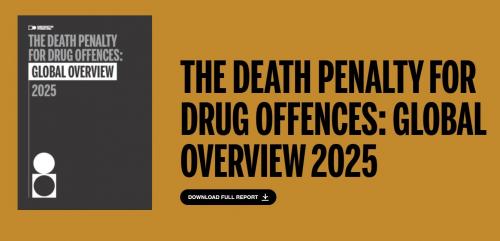
April 14, 2026 - GLOBAL. The Death Penalty for Drug Offences: Global Overview 2025
A Violent Year for Global Drug Control
2025 marked a significant and violent escalation in the use of capital punishment for drug offences. Confirmed drug-related executions increased by 97% between 2024 and 2025, reaching the highest levels recorded globally since Harm Reduction International began tracking this data in 2007. While civil society organisations work tirelessly to track these figures, the global picture remains incomplete due to state secrecy in nations like China, North Korea, and Vietnam. The 2025 spike was driven largely by a small group of countries that have intensified their punitive measures.
Iran: Execution rates spiked amid ongoing political unrest.
Saudi Arabia: A marked escalation in punitive drug control policies.
Singapore & Kuwait: Also contributed to the rising execution count.
Drug Control and the Death Penalty
The data confirms a clear and established trend: punitive drug control is a major driver of the death penalty worldwide. In 2025, drug offences accounted for more than 46% of all confirmed executions globally.
Lack of Deterrance
Despite the heavy reliance on the death penalty, the 2025 World Drug Report indicates that these measures are ineffective.
Global drug markets are expanding, with record-breaking cocaine production.
Rapid increase in the distribution of synthetic substances.
Regions with the highest execution rates (Asia and the Middle East) remain trafficking hotspot
The Human Cost
The application of the death penalty for drug offences frequently targets the most vulnerable members of society including ethnic minorities. In 2025, the demographics of those executed revealed a disturbing trend of targeting low-level or peripheral roles rather than high-level traffickers.
338 people from ethnic minorities, 271 foreign nationals, and 23 women were executed for drug offences in 2025.
Many of those executed faced serious due process violations.
The majority occupied peripheral roles in the drug trade.
By the end of 2025, over 2,450 people remained on death row for drug offences across 22 countries.
Legal Regression
While the world has generally trended toward abolition, 2025 saw significant setbacks. For the first time in over a decade, two countries (Algeria and the Maldives) introduced the death penalty for certain drug offences. These reforms contradict states’ obligations to progressively restrict the use of capital punishment and reverse the global trend towards abolition.
Despite the scale of the crisis, international accountability remains weak. While some actors—including OHCHR, UN human rights experts, and the European Union—have condemned executions and called for moratoria, many states have remained silent. Notably, the UN Office on Drugs and Crime (UNODC) has taken no public position on drug-related executions, while continuing to support counter-narcotics programmes in executing countries.
Lack of Accountability
There is a growing “accountability gap” in international drug policy.
Condemnation: The Office of the High Commissioner for Human Rights, European Union, and UN human rights experts have called for an immediate moratorium.
Silence: The UN Office on Drugs and Crime (UNODC) has maintained a public silence on these executions while continuing to fund counter-narcotics programs in executing states.
The Way Forward
To promote the “health and welfare of mankind,” a fundamental shift in drug policy is required. Continuing the current punitive approach risks complicity in human rights abuses. Global leaders must choose between maintaining a failed, violent status quo or pursuing humane, effective drug policies that move toward the total abolition of the death penalty.