|
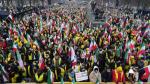
IRAN - 100.000 Iranian exiles demonstrated in Berlin
February 7, 2026: February 7, 2026 - IRAN. 100.000 Iranian exiles demonstrated in Berlin
Tens of thousands of demonstrators gathered at Berlin’s Brandenburg Gate on Saturday in freezing temperatures, marking the anniversary of Iran’s 1979 anti-monarchical revolution and voicing support for protests in Iran. The Express reported that “more than 100,000” people took part, while organizers said some participants and speakers joined remotely after weather disruptions complicated travel. Across the program, speakers conveyed a common political message: rejection of both the shah’s legacy and clerical rule, confidence in the resistance’s organizational strength — especially the PMOI-led Resistance Units — and a transition anchored in the National Council of Resistance of Iran’s Ten-Point Plan.
Mrs. Maryam Rajavi, President-elect of the National Council of Resistance of Iran, in her address to the rally, told the crowd the “countdown” to overthrow had begun and cast the Resistance Units as the uprising’s organized backbone.
“For years and years, we said: overthrow, overthrow,” Mrs. Rajavi said. She warned that monarchist slogans such as “Long Live the Shah” are an attempt to “hijack” the uprising and a “symbol of division” that helps repression.
Stressing “No to Shah, no to the mullahs,” Mrs. Rajavi presented a post-overthrow roadmap: a democratic republic, separation of religion and state, gender equality, and a non-nuclear Iran, with a constituent assembly drafting a new constitution within months. She urged international action focused on practical support for Iranians — including open internet access and legal accountability for senior officials — while insisting regime change must be led by Iranians and their organized resistance.
Charles Michel, former President of the European Council, linked Berlin’s own democratic rupture to Iran’s trajectory, telling the crowd that “no wall is eternal” and that “freedom cannot be defeated forever.”
Former European Council president Michel argued that Europe’s policy must stop treating Tehran as a permanent fixture: “appeasement does not work,” he said, while also insisting that “no foreign military intervention can bring a lasting and stable solution.” In his framing, the missing ingredient is not anger but architecture — an organized alternative that can carry a transition without being captured by power-seekers.
He called the NCRI’s Ten-Point Plan “the right recipe to move from tyranny to democracy,” saying it offers a “solid bridge” from protest to a pluralist republic grounded in free elections, equality, and separation of religion and state. Michel also took aim at monarchist currents, warning Iranians not to let anyone “steal your dreams” or “hijack the future,” portraying restoration politics as another attempt to trade one form of authoritarianism for another.
Mike Pompeo, former U.S. Secretary of State, saluted rallygoers “braving the cold” and then declared the moment bigger than a cycle of unrest: “This isn’t just a protest movement… This is a revolution.”
Former Secretary of State Pompeo stressed that the decisive struggle is internal: “the regime cannot be overthrown from outside,” he said, arguing that outside actors can support but cannot substitute for an organized domestic force. He repeatedly framed the resistance’s strength as its structure — networks that persist under repression — and pointed to Resistance Units as evidence that opposition is not merely rhetorical.
Pompeo also presented the NCRI’s Ten-Point Plan as the practical answer to the two questions he said Western capitals always ask: “Is there an alternative?” and “What happens the day after?” He described the plan as a transition blueprint — toward a secular republic, gender equality, early elections, and a non-nuclear Iran — and warned that any “strongman solution,” including monarchist restoration, would reproduce dictatorship under a different symbol.
Peter Altmaier, former German Federal Minister for Economic Affairs and Energy, argued that Europe should stop waiting for Iran’s rulers to “modernize” and instead align policy with a defined democratic endpoint.
Mr. Altmaier said Iranians had once hoped that a government “without the Shah” would bring democracy — and warned that the current authorities have destroyed any remaining legitimacy by responding to dissent with violence and repression. He urged a tougher European stance, calling for “more and tougher sanctions” and fewer illusions about reform.
Altmaier also treated information as a strategic front: he appealed to newsrooms to “spend more time reporting from Iran,” describing a free press as “the lifeline” for people facing censorship and intimidation. Rather than focusing on personalities, he pointed to the NCRI’s Ten-Point Plan as a benchmark for what a democratic transition should guarantee — freedom, rule of law, and equal rights — and ended with an encouragement aimed at perseverance: “Do not despair. You shall overcome!”
Sabine Leutheusser-Schnarrenberger, former German Federal Minister of Justice, framed the rally as a legal and moral test of Europe’s consistency on rights. “We are in the right place, at the Brandenburg Gate,” she said, tying Germany’s own democratic breakthroughs to Iran’s demand for freedom.
Leutheusser-Schnarrenberger argued that a credible alternative must be measurable in institutions and liberties — “freedom of expression, freedom of assembly, free elections, and the separation of religion and state” — and said these principles are not abstract but life-or-death under a system of detention and coercion. She urged policymakers to put human rights first in any engagement: “The first demand must be: Release the detainees… imprisoned because they took to the streets for their freedom,” she said, also condemning executions and calling for accountability mechanisms that reach decision-makers, not only foot soldiers.
Leutheusser-Schnarrenberger highlighted women’s rights as a core democratic indicator, referencing the right to live without fear for dress, speech, or public presence.
Jalal Khoshkelam, a member of the Central Committee of the Khabat Organization of Iranian Kurdistan, argued that Tehran tried to hide the brutal repression by shutting down communications. The clerical authorities, he said, “cut the internet completely” to create “digital darkness” — but “the truth will not remain hidden.”
Khoshkelam stated that reliable reports and morgue images show the number of dead has “passed thousands,” and said the regime, as always, spilled young people’s blood “without mercy” to survive. He called on the United Nations, the European Union, and the international community to expel the regime’s terrorist diplomats and to close embassies that function as hubs directing operations abroad.
He also urged the removal of relatives of Iranian officials living in Europe and the United States “with stolen money,” insisting, “The blood of our youth is not a red carpet” for them. Ending on a unifying line, Khoshkelam said the struggle would continue “against the Shah and the mullahs” until overthrow, prosecution of perpetrators, and freedom.
Sasan Khatouni, Representative of the Democratic Party of Iranian Kurdistan, argued that Iran’s future hinges on preventing a return to personality-based rule — whether crowned or clerical.
Khatouni said communities on Iran’s periphery have endured repression across both eras and urged that any democratic transition must guarantee equal rights and political inclusion for Iran’s diverse nationalities. He warned that regime change without dismantling authoritarian habits can reproduce dictatorship, especially when politics becomes “person-centered.”
While endorsing unity around a democratic program, Khatouni insisted that real legitimacy requires pluralism, safeguards, and equal citizenship — not a new strongman marketed as a shortcut. He closed with a slogan that aligned with the rally’s central message: “Neither monarchy nor a supreme leader: democracy, equality.”
Naghmeh Rajabi, a NCRI supporter, framed the uprising’s political compass as non-negotiable: no recycling of authoritarianism under a new symbol. The goal, the activist said, is a democratic republic — “not one that swaps the turban for the crown.”
She argued that symbolic steps are insufficient without recognizing the people’s right to resist repression, highlighting Resistance Units as central to confronting the IRGC’s violence.
Rajabi also attacked “fake opposition,” stating that monarchist currents are trying to claim leadership from afar while others “fight” and “shed blood.” Ending with a line aimed at both dictatorships, she said: “Death to the oppressor, whether Shah or the supreme leader.”
Hiva Mohammadi, Iranian youth speaker at the Berlin rally, focused on organization as the resistance’s core strength. She told protesters inside Iran that diaspora demonstrations are meant to signal continuity and support: “you are not alone.” Mohammadi framed the resistance’s strength as disciplined endurance — converting fear and grief into coordinated action — and described Resistance Units as the youth-driven structure that makes protest scalable under heavy repression.
“We do not surrender to grief and paralysis,” she said, describing a shift toward “organized anger” aimed at overthrow. Her remarks echoed rejection of monarchy as a historical lesson, but her emphasis was practical: sustained networks, shared strategy, and a clear democratic destination so that sacrifice is not diverted into another authoritarian project.
https://www.ncr-iran.org/en/news/iran-resistance/thousands-rally-in-berlin-to-reject-monarchical-and-theocratic-rule-back-irans-uprising/ (Source: Ncr-Iran)
|